
Emergent Strategy: A Path Toward Sustainable Success
An evidence-based case for emergent strategy: why the next step matters more than the perfect plan, for entrepreneurs, for organizations in transition, and for the debate about artificial intelligence.
The hesitation I keep seeing
I work with entrepreneurs, family businesses, and students across South Florida who have real ideas, often ideas that use technology in ways I would not have imagined five years ago. And I keep watching the same thing happen. The idea is sound. The person is capable. And then the process stalls in front of a small, concrete action: making the first sales call, taking out a modest loan, paying for the website, commissioning the logo, ordering the materials.
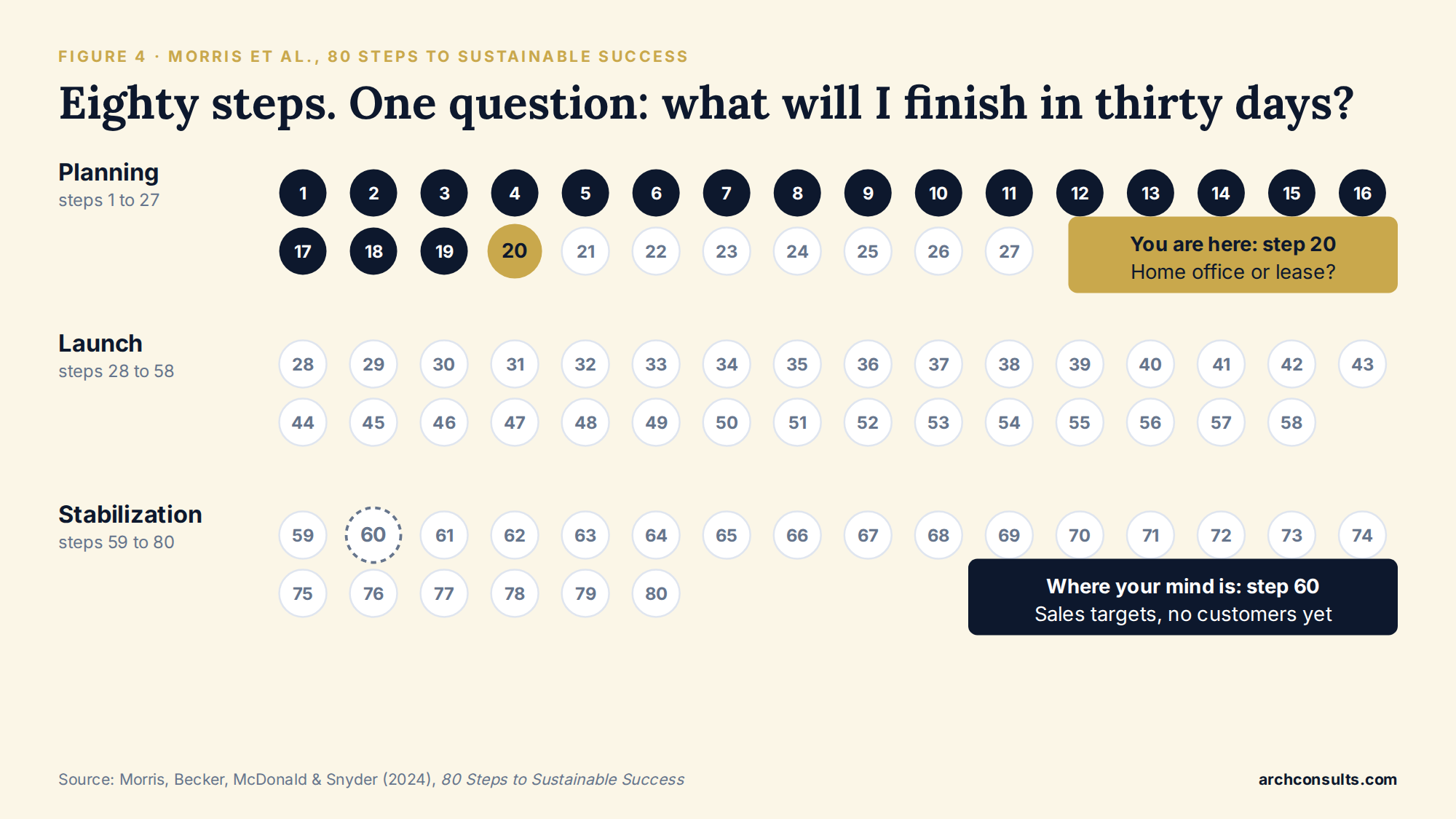
It is rarely laziness. In most cases it is the opposite. It is a form of over-planning, a reluctance to move until the whole path is visible. Michael Morris and his colleagues built a framework I use with the entrepreneurs I advise called 80 Steps to Sustainable Success. The pattern I see is an entrepreneur standing on step 20, deciding whether to work from home or lease a space, while mentally wrestling with step 60, setting monthly sales targets for a business that does not yet have a single customer. The distance between those two steps is exactly where ventures die.
This article makes an academic case for a different posture. Not the only posture, but a legitimate one with decades of scholarship behind it: emergent strategy. Let the strategy emerge from action. Mitigate the risk you can see, then start, get your hands dirty, learn, and adjust. I will define what emergent strategy is, show you the scholars and the organizations that support it, give the strongest case for the opposite view, and then connect all of it to the entrepreneurial process, the business life cycle, and a debate that is very much alive right now about whether the world should slow down artificial intelligence.
What emergent strategy actually is
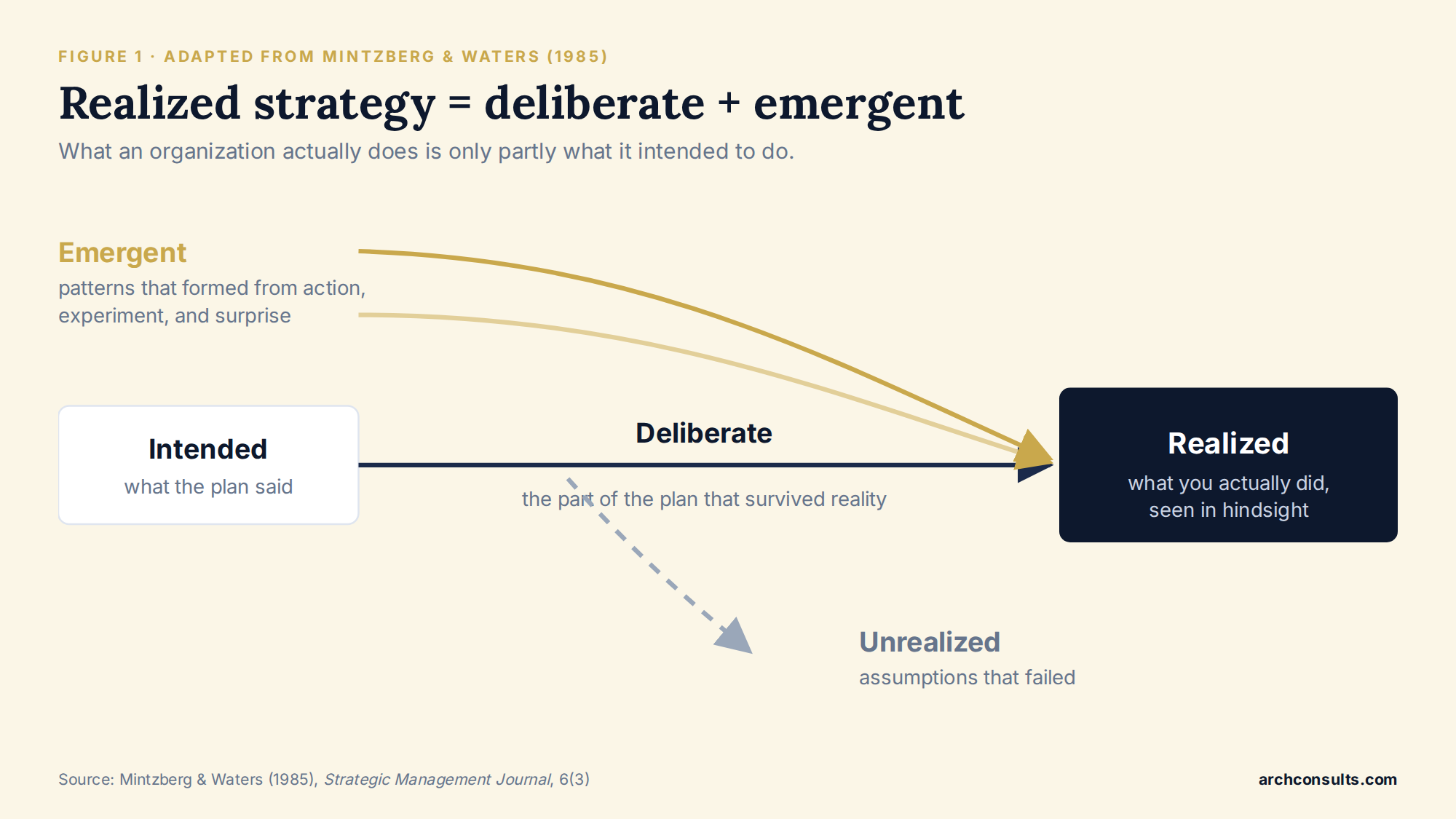
The idea traces to Henry Mintzberg. In a 1985 paper with James Waters, Mintzberg proposed that the strategy an organization actually realizes is never simply the strategy it intended. Some of the intended strategy is realized; call that the deliberate part. Some is never realized because the environment changes or the assumptions fail; that is the unrealized part. And a surprising share of what a company ends up doing was never planned at all. It emerged from actions, experiments, and responses to circumstances that the planners could not foresee. Mintzberg’s definition of strategy is deliberately humble: a pattern in a stream of decisions. Strategy is not only what you say you will do. It is what you actually did, viewed in hindsight.
Mintzberg’s 1987 essay “Crafting Strategy” gave the idea its most useful image. A potter at the wheel does not draw the pot first and then execute the drawing. She has an intention, her hands are on the clay, and the form takes shape through the feedback between the two. Strategy, he argued, works the same way. Formulation and implementation are not two phases. They are one continuous act of learning.
The practical implication for a founder is significant. If realized strategy is largely emergent, then the quality of your strategy depends less on the quality of your forecast and more on the quality of your feedback loops: how quickly you act, how honestly you observe the result, and how willing you are to let the pattern change.
The scholarly case for emergent strategy
Mintzberg is not alone, and the supporting literature spans strategy, organizational theory, and entrepreneurship.
James Brian Quinn (1980) studied how large firms actually made strategic change and called what he found logical incrementalism: executives moved in deliberate small steps, keeping options open, learning as they went, and committing fully only after the picture clarified. Robert Burgelman (1983, 1991) documented how much of a corporation’s strategic renewal comes from autonomous strategic behavior, initiatives that bubble up from middle managers and engineers outside the official plan. Karl Weick’s work on sensemaking (1995) explains why: in genuinely novel situations people cannot plan their way to understanding, they act their way to it. Action produces the information that planning was waiting for.
Effectuation and the lean startup
In entrepreneurship the strongest statement of this logic is Saras Sarasvathy’s theory of effectuation (2001). Studying expert entrepreneurs, she found that they do not typically begin with a fixed goal and then assemble the means. They begin with the means they already have (who they are, what they know, whom they know), take actions whose downside they can afford to lose, form partnerships with whoever is willing to commit, and treat surprises as raw material rather than threats. These principles were later given memorable names: bird-in-hand, affordable loss, crazy quilt, and lemonade. The unifying idea is that in an unpredictable environment, control beats prediction: you shape the future through what you do rather than forecasting it and hoping.
Eric Ries’s The Lean Startup (2011) turned the same logic into a management practice. The build-measure-learn loop treats every business assumption as a hypothesis to be tested cheaply and early. Kathleen Eisenhardt and Donald Sull (2001) showed that firms in fast-moving markets often outperform with simple rules rather than elaborate plans, a handful of guardrails that let people act quickly inside clear boundaries. And Jeffery McMullen and Dean Shepherd (2006) reframed the very definition of entrepreneurship as action under uncertainty: the entrepreneur is not the person with the best plan but the person willing to act before the uncertainty resolves.
Why progress begets progress
Finally, there is the psychology of progress itself. Teresa Amabile and Steven Kramer (2011) found across thousands of daily work diaries that the single strongest predictor of motivation was making progress in meaningful work, even small progress. Karl Weick made the same argument decades earlier in “Small Wins” (1984): large problems paralyze, but a small concrete win changes what seems possible and pulls the next win toward it. Morris and his co-authors put it in four words in the 80 Steps handbook: progress begets progress.
Organizations built on emergent strategy
The classic case is Honda’s entry into the American motorcycle market, told by Richard Pascale (1984). The Boston Consulting Group’s retrospective analysis described a deliberate, brilliantly executed plan. The Honda managers who actually did it told a different story. They arrived in Los Angeles in 1959 intending to sell large motorcycles, the bikes leaked oil and broke down, and out of near-failure they noticed that Americans were fascinated by the small 50cc Supercubs the team was riding for errands. The strategy that made Honda a household name in the United States was not in the plan. It was noticed, then nurtured.
Intel’s exit from memory chips, documented by Burgelman (1994), is the corporate version. Intel’s official strategy through the early 1980s was to be a memory company. But its internal rule for allocating scarce manufacturing capacity to the highest-margin products had quietly shifted the factories toward microprocessors long before top management admitted the memory business was lost. As Andy Grove later put it, the strategy had already changed on the ground; leadership’s job was to recognize it and make it deliberate.
3M, Amazon, Slack, and Instagram
The pattern repeats across the last several decades. 3M’s Post-it Note came from an adhesive that was too weak for its intended purpose and a scientist who wanted a bookmark that would stay in his hymnal. Amazon Web Services began as internal infrastructure that Amazon realized other companies would pay to use; it now generates a large share of the company’s operating profit. Slack was the internal chat tool of a failed video game company called Glitch. Instagram began as a cluttered check-in app called Burbn; the founders noticed that the photo feature was the only thing people used, cut everything else, and relaunched. In each case emergent strategy did the work: a capable team started, paid attention, and let the realized strategy diverge from the intended one.
The steelman: why planning and capability still matter
It would be dishonest to leave it there. There is a rigorous case for deliberate strategy, and every entrepreneur should understand it.
Igor Ansoff (1965) built the discipline of strategic planning on the observation that unstructured decisions in a turbulent environment waste resources; analysis before commitment protects the firm. Michael Porter (1980, 1996) argued that strategy is fundamentally about choice and trade-offs: choosing a position, deciding what not to do, and aligning activities so they reinforce one another. That kind of coherence rarely emerges by accident. Jay Barney’s resource-based view (1991) and David Teece’s work on dynamic capabilities (1997) add the internal side: sustainable advantage comes from resources and capabilities that are valuable, rare, and hard to imitate, and you cannot build those without knowing what you have and where you are going. Understanding your capabilities and your resource requirements is not bureaucracy. It is the difference between an experiment you can afford and one that ends the company.
What the evidence says about planning
The empirical evidence is also more favorable to planning than the popular narrative suggests. Frédéric Delmar and Scott Shane (2003) followed more than two hundred Swedish new ventures for thirty months and found that those who wrote business plans were less likely to fail and moved faster into product development and organizing. A meta-analysis by Brinckmann, Grichnik, and Kapsa (2010) pooled dozens of studies and concluded that business planning is positively related to venture performance, with a useful nuance: the benefit is larger for established firms than for brand-new ones, and the authors conclude that the best results come when planning is combined with learning rather than treated as a one-time deliverable.
Planned emergence
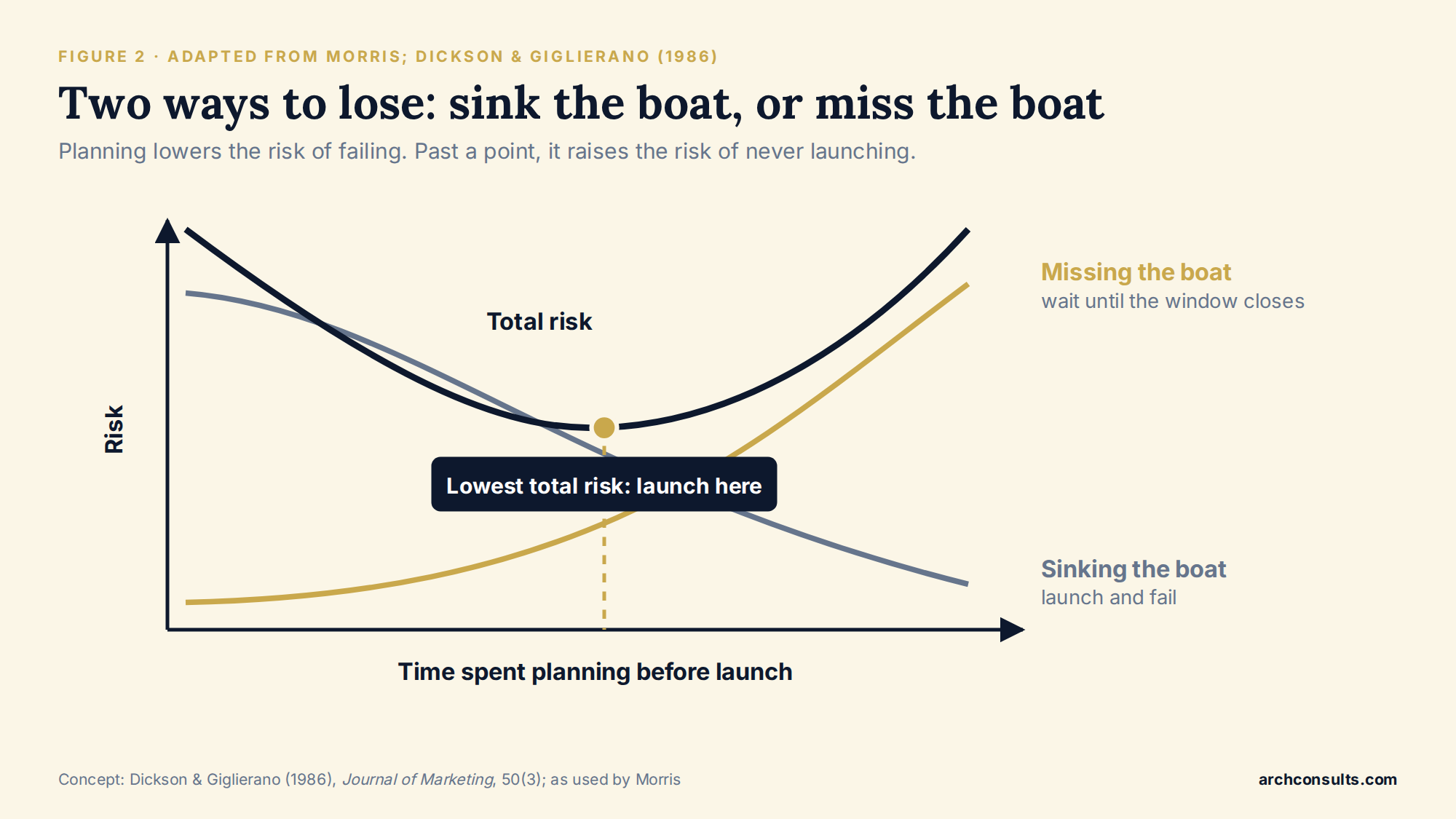
Even the champions of emergence do not dismiss planning. Robert Grant (2003) studied the oil majors and found they had evolved a system he called planned emergence: corporate leadership set direction, guardrails, and performance expectations, while business units adapted freely within them. Mintzberg himself wrote that purely deliberate and purely emergent strategies are both rare and that real strategy lives on the continuum between them. And Morris, drawing on Dickson and Giglierano (1986), frames the risk on both sides clearly: there is sinking-the-boat risk, launching and failing, and there is missing-the-boat risk, waiting so long to launch that the opportunity closes. Planning reduces the first. Past a certain point it increases the second. Total risk is minimized somewhere in the middle, and that point arrives sooner than most people think.
So the honest position is not “plan” versus “act.” It is: plan enough to make the next step survivable, then take it.
Where the two logics meet: the entrepreneurial process and the life cycle
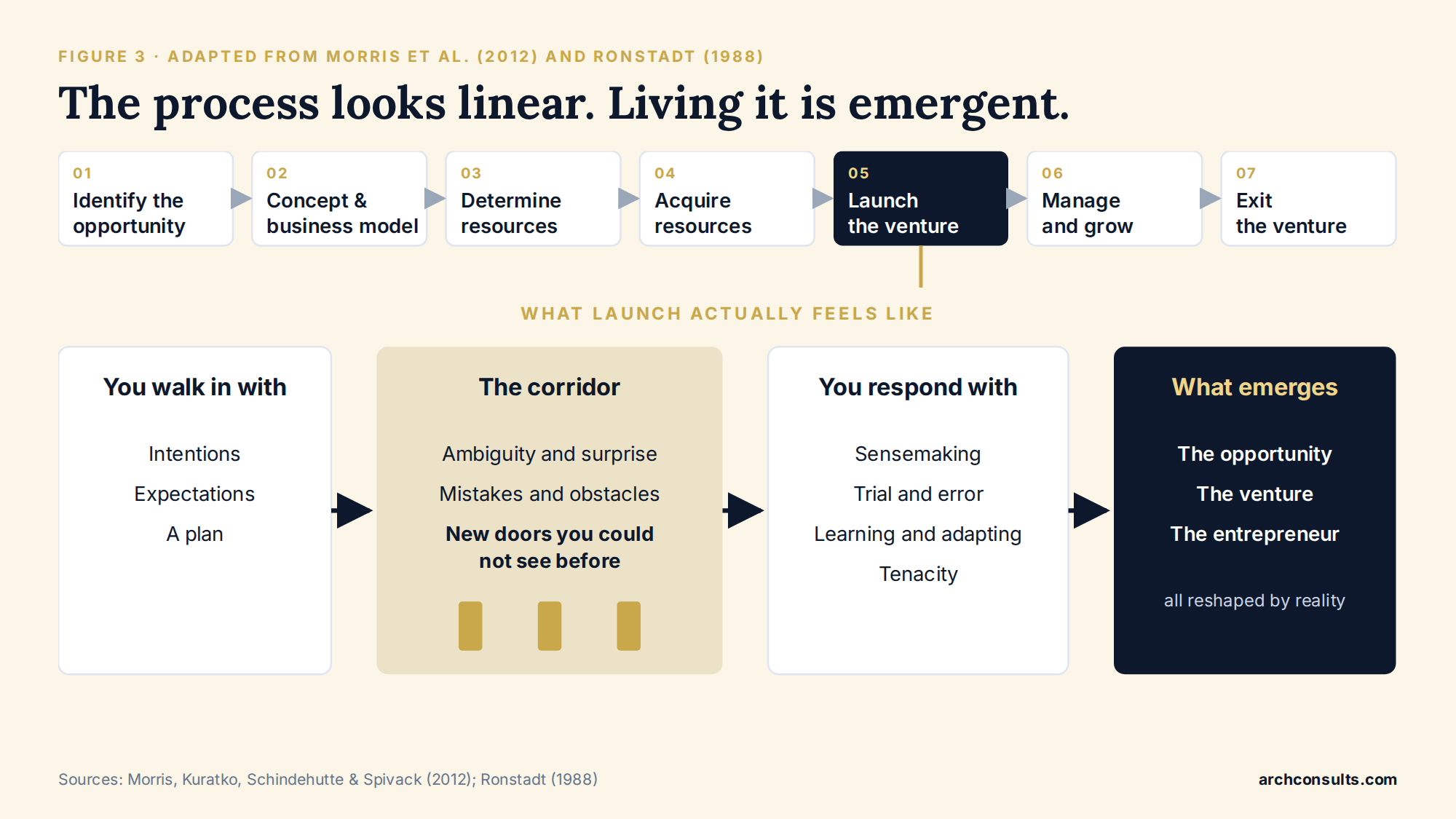
The entrepreneurial process, as Morris describes it, moves through a sequence: identify an opportunity, develop the concept and business model, determine the required resources, acquire those resources, launch the venture, implement and manage and grow it, and eventually exit. Drawn on a slide it looks linear. Lived, it is anything but.
Morris, Kuratko, Schindehutte, and Spivack (2012) describe what they call the emergent nature of venture creation. The entrepreneur enters launch with intentions and expectations. What launch actually delivers is ambiguity, novelty, uncertainty, mistakes, resistance, obstacles, surprises, and, importantly, new opportunities that were invisible from the outside. The entrepreneur responds with sensemaking, trial and error, learning, creativity, adaptation, tenacity, and resilience. And what emerges is not just the venture but the opportunity itself, reshaped by contact with reality, and the entrepreneur, reshaped by the experience. Robert Ronstadt (1988) called the underlying mechanism the corridor principle: starting a venture opens a corridor of doors you could not see from the starting line. You have to be in the corridor to see the doors.
Emergent strategy across the life cycle
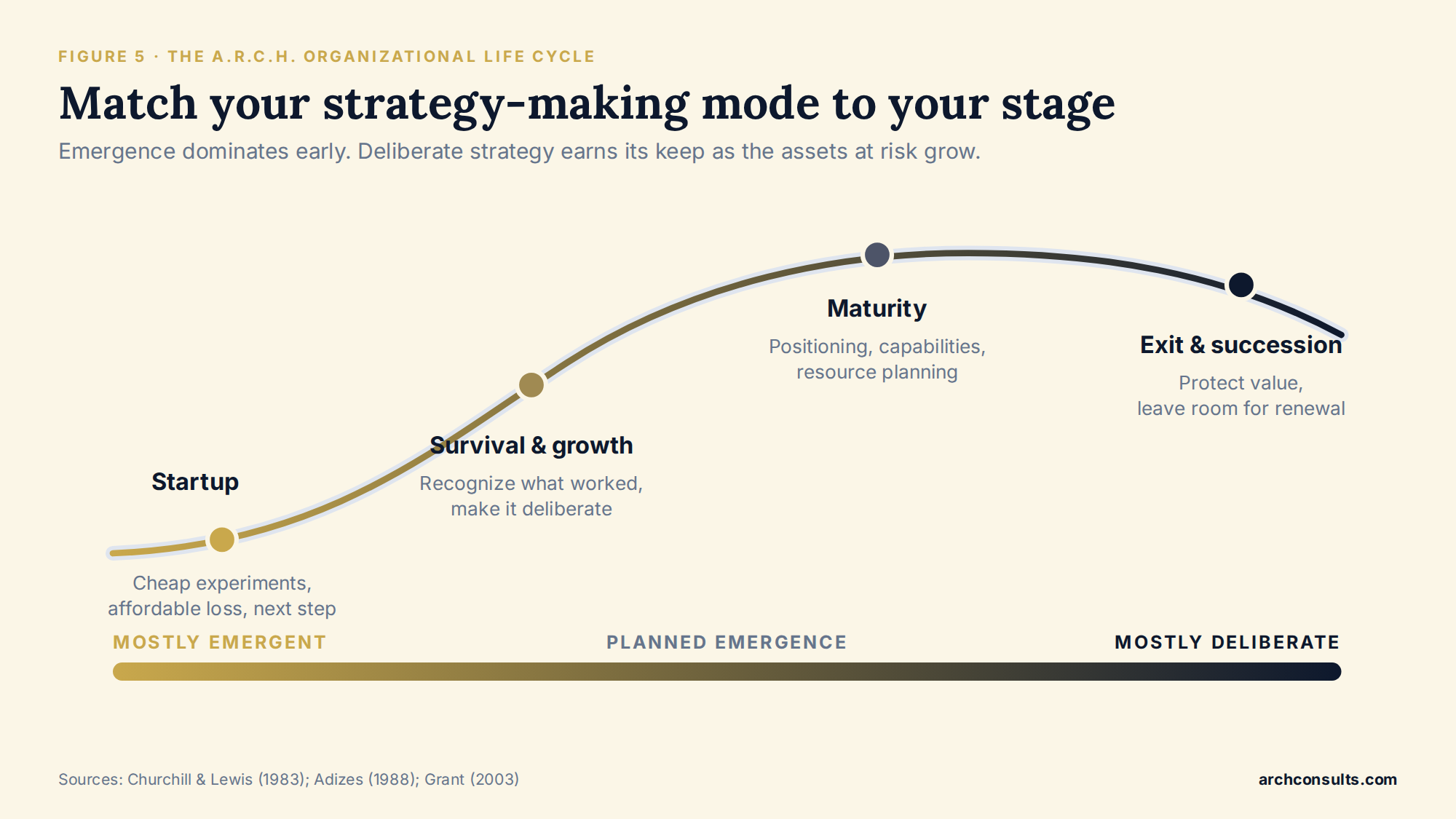
Here is the synthesis. The deliberate logic of corporate strategy and the emergent logic of entrepreneurship are not rivals. They are appropriate at different stages of the same life cycle. Churchill and Lewis (1983) described small business growth through existence, survival, success, take-off, and resource maturity. Ichak Adizes mapped the same arc as courtship, infancy, go-go, adolescence, prime, and beyond. At A.R.C.H. we frame it as development and startup, survival and rapid growth, early and late maturity, and exit, harvest, or succession. In the earliest stages the environment is most uncertain and the cost of a wrong plan is highest relative to the cost of a cheap experiment, so emergence should dominate. As the business stabilizes and the assets at risk grow, deliberate strategy earns its keep: capability audits, positioning choices, resource planning, formal control.
This is the core of what I mean by organizational health. A healthy organization matches its strategy-making mode to its stage. The founder who still runs a ten-year-old company on improvisation has a health problem. So does the new venture that has spent eighteen months on a business plan and has not made a sale. What got you here will not get you there, and the reverse is also true: what will get you there would have prevented you from getting here.
Eighty steps and the only one that matters
Morris and his colleagues developed 80 Steps to Sustainable Success precisely because they saw entrepreneurs, especially those without a financial safety net, freeze in front of the five-year business plan. Their answer was what they call stepwise logic. The journey to a sustainable business is broken into eighty concrete activity steps across three phases: twenty-seven in planning, thirty-one in launch and early operations, and twenty-two in stabilization. Some steps are small (choose a name). Some are substantial (create and launch a website, make the first sale). The instruction is not to master all eighty. It is to ask one question: how many steps will I complete in the next thirty days? Then, based on that progress, ask it again.
Notice what this framework quietly does. It is a plan, so it honors the planning literature. But it is a plan of actions rather than a plan of forecasts, so it honors the emergent literature. It forces the entrepreneur to learn by doing, to build capability step by step, and to let the eventual business plan be written from experience rather than imagination. It is, in effect, emergent strategy with guardrails, or planned emergence for a one-person company.
And it exposes the real cost of overthinking. The entrepreneur on step 20 who is agonizing over step 60 is not planning. They are forecasting a future they have no data about. The data arrives on steps 21 through 59. The Morris handbook’s preface says it plainly: writing a business plan is important, but it should not be a roadblock to starting a business. Get out there. Make some sales. The plan will come with time.
Emergent strategy and the AI debate
I want to bring this to a much larger stage, because the same error is being made there.
This week’s episode of Moonshots with Peter Diamandis (recorded September 16, 2026) discussed the growing push from frontier lab leaders to pace or slow AI development, and what a coordinated slowdown or a new regulatory body would actually mean. The most useful moment for me was Wissner-Gross’s description of the old debate inside the AI alignment community. One camp believed safety required a single decisive algorithm, a master plan discovered in advance by a great mind. The other camp, associated with Paul Christiano, argued for what came to be called prosaic alignment: there is no magic algorithm. Safety would come from a lot of data, a lot of humans interacting with the systems, and continual correction. Messy, iterative, and, in Wissner-Gross’s own word, emergent. History has largely vindicated the second camp; the techniques that actually made today’s models usable came from exactly that loop.
That is Mintzberg. That is Sarasvathy. That is the entrepreneur in the corridor.
Why a master plan for AI is a forecast in disguise
Consider what a comprehensive, restrictive AI strategy would require: an accurate forecast of where the technology will be in five years, what it will be capable of, who will misuse it and how, and which restrictions will prevent that misuse without preventing the benefits. Nobody has that forecast. David Collingridge described the trap in 1980: early in a technology’s life we lack the knowledge to regulate it well, and by the time we have that knowledge the technology is entrenched and hard to change. Frank Knight (1921) distinguished risk, which can be quantified and insured, from uncertainty, which cannot. Superintelligence is uncertainty. You do not manage uncertainty with a master plan. You manage it the way healthy organizations and expert entrepreneurs manage it: with clear guardrails, affordable-loss experiments, honest measurement, and rapid adjustment.
The Moonshots panel also discussed a list circulating online of what humanity has not yet solved and what AI might: aging, cancer, Alzheimer’s, heart disease, and the rest. Every month of delay has a cost measured in people. That is missing-the-boat risk at civilizational scale. I am not arguing against doing what we can with what we know now. Anthropic’s own threat reporting, cross-lab safety coordination, and independent evaluation are exactly the kind of guardrails that planned emergence calls for. I am arguing against the belief that a sufficiently detailed strategy written this early can be anything other than a forecast dressed up as a plan, and against restraining the capacity of these systems before we have learned what they can do.
Why this is personal
I have two sisters with disabilities. One of them is autistic and has been nonverbal her entire life. She communicates; anyone who has spent time with her knows that. She simply cannot use her words. For most of my life the tools available to her were limited, and the researchers working on the problem were few. I now believe it is entirely plausible that systems built on the models being debated today will give her a voice, whether through interpreting her signals, translating her intent, or something none of us has imagined yet. That will not come from a plan written in 2026. It will emerge from thousands of people building, testing, and learning.
My father and my stepmother are getting older. I want them to live as long as possible and as well as possible, and I have watched enough of what AI is already doing in drug discovery, diagnostics, and personalized care to know that the difference between building and waiting is not abstract. It is measured in years with the people I love.
So when I encourage an entrepreneur to make the call, to take the small loan, to order the materials and let the strategy emerge, I am not being cavalier about risk. I have run a company, I have sat on the board of a company we co-founded, and I have counseled family businesses through the transitions that break most of them. I am saying that the risk of not moving is real, it is under-counted, and the people who wait for certainty tend to wait forever.
A practical posture for emergent strategy
If you take one thing from this article on emergent strategy, take a posture rather than a rule. Reduce the risk you can see: know your affordable loss, understand what resources and capabilities you actually have, and set a few simple guardrails you will not cross. Then take the next step, not the sixtieth. Treat every action as an experiment that produces information, and review that information on a fixed rhythm, thirty days is a good one. When the pattern in your actions starts to show you a strategy you did not intend, do what Honda and Intel did: recognize it, and make it deliberate. And as the business matures, let the balance shift. Plan more as you learn more. That is not abandoning emergence. That is what emergence is for.
Keep learning
If you want the full academic grounding behind this article, my eight-part course Strategic Management: From Analysis to Competitive Advantage on The Dr. Claude Kershner Show walks from the fundamentals of strategy and return on invested capital, through external analysis (Porter’s Five Forces and the Uber case), internal analysis (VRIO, the value chain, and the Toyota case), business-level and functional-level strategy, strategy and technology, and finally entrepreneurial growth strategies for sustained competitive advantage. Start with “What Is Strategy: How Companies Compete and Win” and work forward.
And if you want to know which life cycle stage your organization is in, and therefore which strategy-making mode it needs, the Org Life Cycle Map in the Kershner Lab is a five-minute place to start.
Take the next step
If your organization is standing on step 20 and staring at step 60, whether that is a South Florida founder who cannot make the first call or a mature company that cannot decide about AI, request a first conversation with A.R.C.H. Bring the transition, what is at risk, and the outcome that must be protected. We will help you find the next step.
Sources
Adizes, I. (1988). Corporate lifecycles: How and why corporations grow and die and what to do about it. Prentice Hall.
Amabile, T. M., & Kramer, S. J. (2011). The power of small wins. Harvard Business Review, 89(5), 70–80.
Ansoff, H. I. (1965). Corporate strategy. McGraw-Hill.
Barney, J. (1991). Firm resources and sustained competitive advantage. Journal of Management, 17(1), 99–120.
Brinckmann, J., Grichnik, D., & Kapsa, D. (2010). Should entrepreneurs plan or just storm the castle? A meta-analysis on contextual factors impacting the business planning–performance relationship in small firms. Journal of Business Venturing, 25(1), 24–40.
Burgelman, R. A. (1983). A process model of internal corporate venturing in the diversified major firm. Administrative Science Quarterly, 28(2), 223–244.
Burgelman, R. A. (1994). Fading memories: A process theory of strategic business exit in dynamic environments. Administrative Science Quarterly, 39(1), 24–56.
Churchill, N. C., & Lewis, V. L. (1983). The five stages of small business growth. Harvard Business Review, 61(3), 30–50.
Collingridge, D. (1980). The social control of technology. Frances Pinter.
Dickson, P. R., & Giglierano, J. J. (1986). Missing the boat and sinking the boat: A conceptual model of entrepreneurial risk. Journal of Marketing, 50(3), 58–70.
Delmar, F., & Shane, S. (2003). Does business planning facilitate the development of new ventures? Strategic Management Journal, 24(12), 1165–1185.
Diamandis, P., Ismail, S., Blundin, D., & Wissner-Gross, A. (2026, September 17). Musk, Altman & Dario say slow down, OpenAI delays IPO, Grok builds a company live [Episode 291]. Moonshots. https://youtu.be/DrV4WwNEAZE
Eisenhardt, K. M., & Sull, D. N. (2001). Strategy as simple rules. Harvard Business Review, 79(1), 106–116.
Grant, R. M. (2003). Strategic planning in a turbulent environment: Evidence from the oil majors. Strategic Management Journal, 24(6), 491–517.
Knight, F. H. (1921). Risk, uncertainty and profit. Houghton Mifflin.
McMullen, J. S., & Shepherd, D. A. (2006). Entrepreneurial action and the role of uncertainty in the theory of the entrepreneur. Academy of Management Review, 31(1), 132–152.
Mintzberg, H. (1987). Crafting strategy. Harvard Business Review, 65(4), 66–75.
Mintzberg, H. (1994). The rise and fall of strategic planning. Free Press.
Mintzberg, H., & Waters, J. A. (1985). Of strategies, deliberate and emergent. Strategic Management Journal, 6(3), 257–272.
Morris, M. H., Becker, R., McDonald, S., & Snyder, P. (2024). 80 steps to sustainable success: The UPBI handbook on building a business. UPBI Press.
Morris, M. H., Kuratko, D. F., Schindehutte, M., & Spivack, A. J. (2012). Framing the entrepreneurial experience. Entrepreneurship Theory and Practice, 36(1), 11–40.
Pascale, R. T. (1984). Perspectives on strategy: The real story behind Honda’s success. California Management Review, 26(3), 47–72.
Porter, M. E. (1996). What is strategy? Harvard Business Review, 74(6), 61–78.
Quinn, J. B. (1980). Strategies for change: Logical incrementalism. Irwin.
Ries, E. (2011). The lean startup. Crown Business.
Ronstadt, R. (1988). The corridor principle. Journal of Business Venturing, 3(1), 31–40.
Sarasvathy, S. D. (2001). Causation and effectuation: Toward a theoretical shift from economic inevitability to entrepreneurial contingency. Academy of Management Review, 26(2), 243–263.
Teece, D. J., Pisano, G., & Shuen, A. (1997). Dynamic capabilities and strategic management. Strategic Management Journal, 18(7), 509–533.
Weick, K. E. (1984). Small wins: Redefining the scale of social problems. American Psychologist, 39(1), 40–49.
Weick, K. E. (1995). Sensemaking in organizations. Sage.